Every Minute Counts: How AI Powers Demand Intake at Freight Tiger Marketplace
By
Freight Tiger Newsdesk
·
4 mins read

Freight Tiger operates a two-sided marketplace: LSPs — logistics service providers — bring freight demand, and fleet owners provide transportation capacity. When an LSP receives a freight requirement, they are typically reaching out to more than one marketplace at the same time. The first platform to surface qualified transporters and secure a commitment wins the business.
In that context, how quickly demand enters the system — and how accurately — shapes everything that follows. So, speed is not just an advantage; it is often the difference between winning and losing a placement.
Demand Flows In — From Wherever It Is Shared
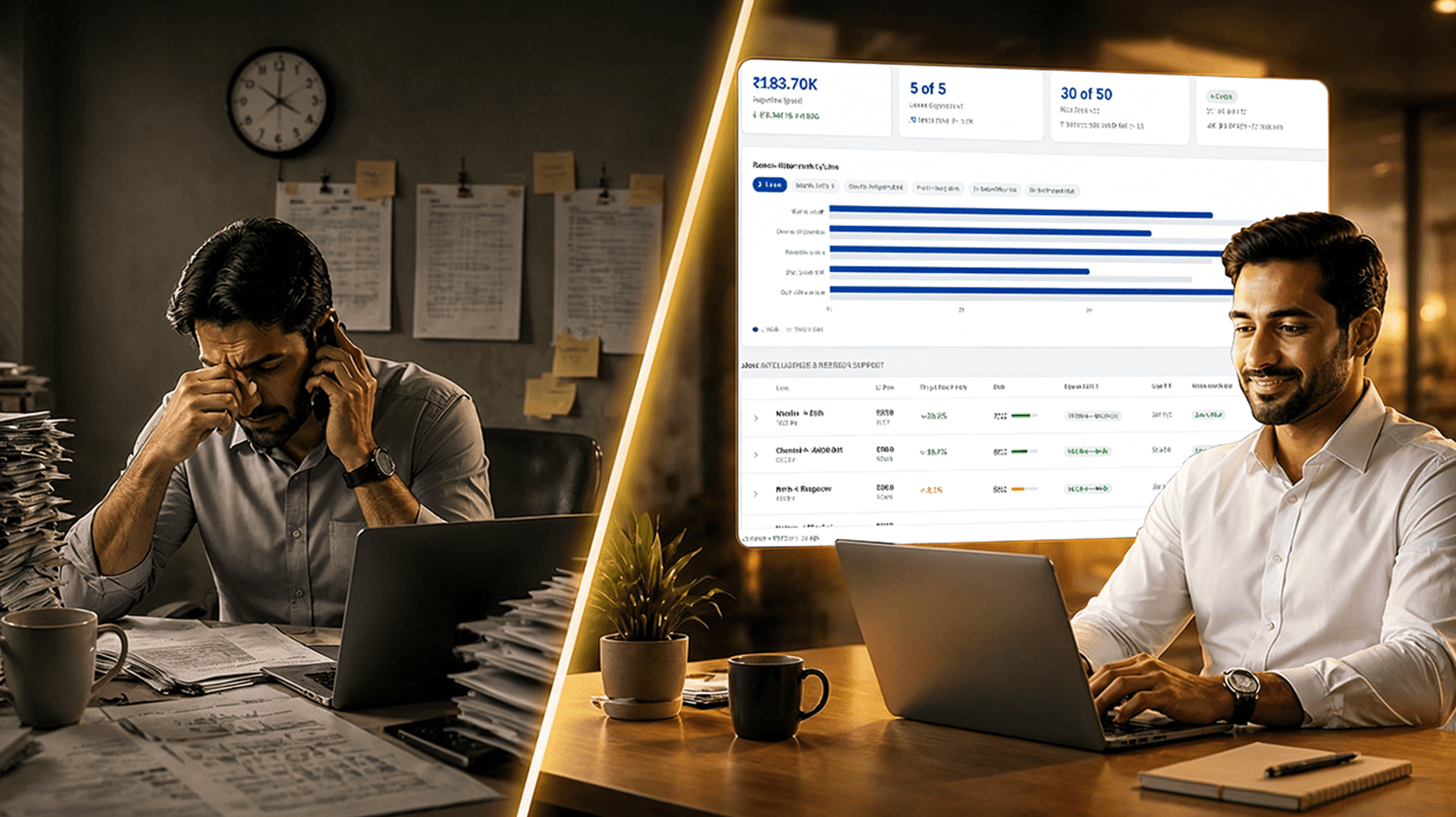
In India’s logistics ecosystem, freight requirements do not arrive through a single, orderly channel. They never have. A load requirement comes in over WhatsApp from one customer. An email lands from another. A call comes in while both are still unread. And then another WhatsApp message. And another call.
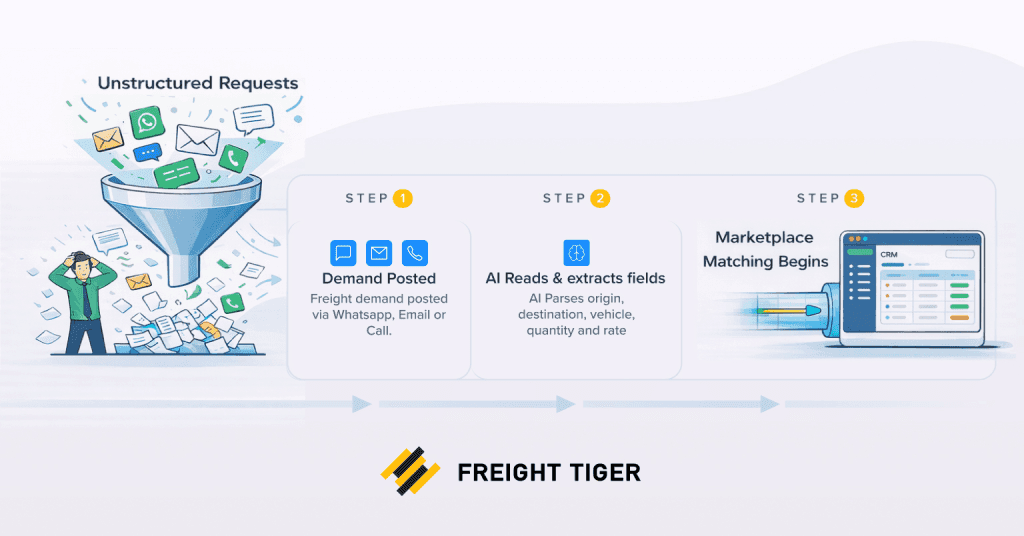
The person handling freight demand is expected to manage everything at once — WhatsApp, a flooded inbox, and a ringing phone — with no queue, no prioritisation, no system.
Things slip. A message gets buried. An email sits unread. A phone requirement never makes it in. These aren’t failures of effort — they’re the inevitable result of a people-dependent process overwhelmed by volume.
And in freight, a missed requirement is lost business. LSPs are reaching out to multiple platforms simultaneously. If you don’t respond in time, the load moves on.
Freight Tiger replaces that model entirely. The platform aggregates demand from every channel — WhatsApp, email, and calls — and processes it automatically, the moment it arrives. No manual step. No dependency on someone being available.
Built on Deep Freight Domain Knowledge
Freight demand messages are not structured information. Traffic managers use shorthand city pairs, abbreviated vehicle types, and a style of communication that is efficient for experienced logistics professionals — but requires genuine domain understanding to interpret correctly.
Our AI layer is trained specifically on this language. A message like “Need 32 ftr MUM–PNE tmrw 10am” is read correctly as a 32-footer vehicle requirement from Mumbai to Pune, departing the following morning. Origin, destination, vehicle type, quantity, rate — all extracted accurately, without any human in the loop.
This accuracy matters because a misread demand is worse than a missed one. Getting the vehicle type wrong means mismatched supply. Getting the lane wrong means the wrong transporters respond. The domain training behind the AI layer is what makes automated intake operationally reliable, not just technically possible.
Exceptions are handled explicitly — nothing is silently dropped
When a message is incomplete — a missing destination, an unrecognised vehicle type — it does not get lost. It triggers a Human In The Loop (HITL) workflow, where the unresolved message enters an exception queue with a specific reason attached, so the operations team can resolve it quickly. Every resolution feeds back into the system. Over time, the exception rate falls as the AI learns from real operational patterns.
Supply gets the full response window
When demand is in the marketplace the instant it is shared, transporters have the maximum possible time to evaluate the requirement and place a bid. A demand that enters the system 30 to 40 minutes late has already lost that window. On Freight Tiger, the window is preserved from the moment the requirement is posted.
Operations teams focus on placement, not data entry
Reading a WhatsApp message, interpreting shorthand, entering fields into a system — this is mechanical work. On Freight Tiger, it is handled automatically. Operations teams use that time for what actually requires judgement: managing placements, building transporter relationships, resolving escalations, and responding to customers when it matters most.
Volume grows without proportional headcount
Demand volume across cities grows continuously. On most networks, keeping up with that growth means hiring more people to process it. Because demand intake on Freight Tiger is automated end-to-end, growth in demand volume does not translate directly into growth in operational headcount. The platform absorbs more without requiring more people to run it.
“Before this system, our team spent the first two hours of every shift just entering demands from WhatsApp and email. Now that time goes into working with transporters and optimising placements. The difference in our placement numbers has been significant.”
— Ravi Teja, Operations Head, Freight Tiger Bangalore
What’s Next
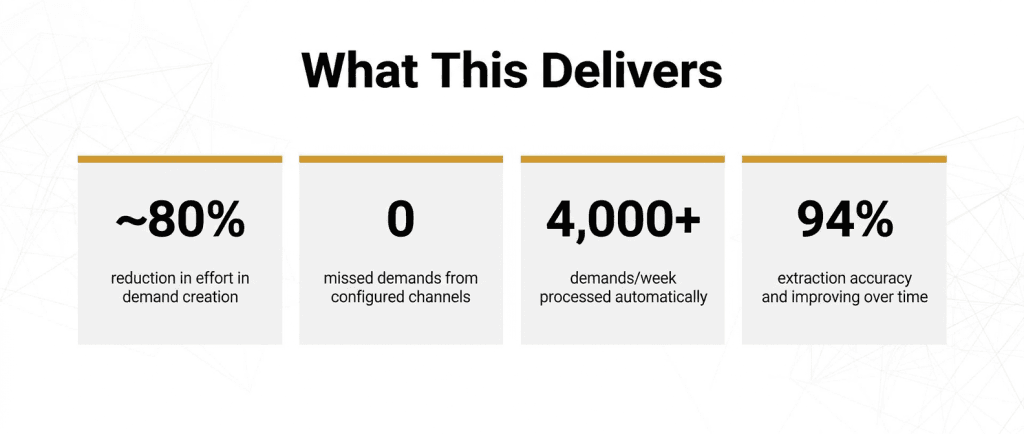
The demand aggregation and auto-intake capability described here has been deployed and battle-tested within Freight Tiger’s own marketplace operations — processing thousands of real requirements across live channels. We ran it, refined it, and validated it against real placement outcomes.
This capability is now available for external LSPs and freight brokers; they can now plug into the same capability — bringing all inbound demand across WhatsApp, email into a single automated flow, with no manual entry and no missed requirements.
We are offering a tested, proven solution for our partners to run better, leaner, and faster.
Technology at Freight Tiger is not a layer on top of operations. It is how operations works.
Demand intake is one illustration. The same principle — automate what is mechanical, apply expertise where it creates value — runs across how we handle tracking, freight invoicing, transporter engagement, and customer visibility. This is what it means to run a technology-first freight marketplace.

authored by
Freight Tiger Newsdesk
published on
Get our resources to your inbox
Get our latest blog posts, videos, webinars, case studies, whitepapers and events, straight in your inbox. No spam, we promise.